Church Body Pledges to Engage Government on NDS2


The Zimbabwe Council of Churches (ZCC) has committed to engaging the government on policies that will drive development across all sectors of the economy as it prepares to launch the National Development Strategy 2 (NDS2).
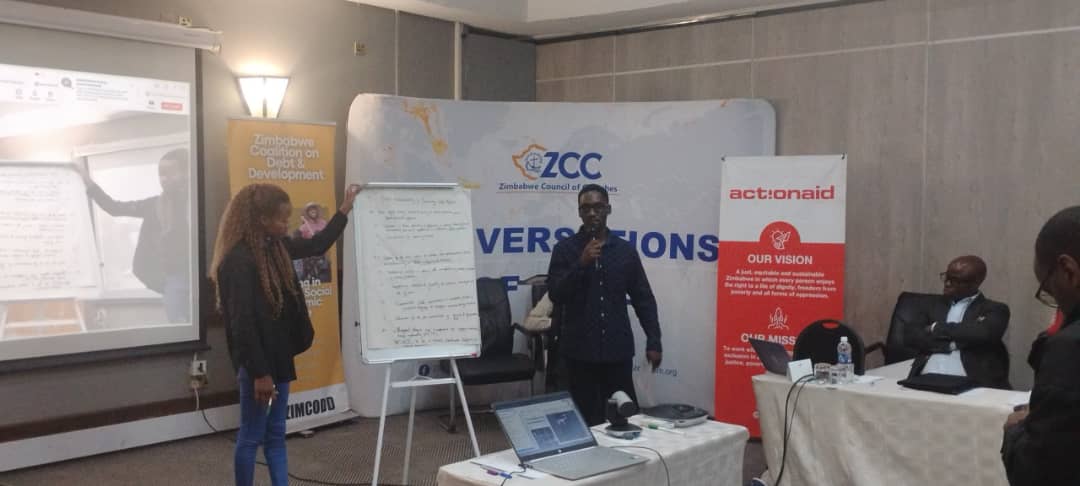
This commitment was made during a post-reflection workshop in Harare, where the church body discussed financing for sustainable development, drawing from key takeaways from the recent Servilla conference in Spain.
In collaboration with civil society organizations such as ActionAid, ZiMCOD, and the Zimbabwe Congress of Trade Unions (ZCTU), the ZCC has pledged to promote inclusive dialogue with the government and advocate for transparent policy formulation. This, they believe, will help Zimbabwe address its debt deficit, which currently stands at $21.5 billion.
According to the Minister of Finance, Economic Development, and Investment, Mthuli Ncube, Zimbabwe’s debt comprises $12.6 billion in external stock and $8.8 billion in domestic debt, bringing the debt-to-GDP ratio to 44%. Speaking to journalists on the sidelines of the conference, Vimbai Mushongera, a ZCTU representative, emphasized the need for unity between the government and civil society organizations to drive development and pay back creditors.
“It’s time for us to have meaningful engagement and dialogue that speaks directly to our concerns and those of the country,” Mushongera said. “We need to build a strong front to confront creditors and advocate in one voice for the things that affect us.”
When asked why civil society organizations’ engagements often remain theoretical and fail to yield tangible solutions, Admire Mtizwa, ZCC Program Director, responded, “We are at an advantage now, as our government is currently consulting for NDS2. As civil society organizations, we need to strengthen our coordination and make concrete inputs into the NDS2, connecting the outcomes of the Financing for Development conference to the realities on the ground.”
Under the NDS1, the government made significant strides in transport, agriculture, and infrastructure development. The commissioning of the modern multilevel Trabelas interchange by President Emmerson Mnangagwa in May this year is a testament to this progress. However, despite these developments, Zimbabwe still lags behind in terms of world-class infrastructure, which requires continuous upgrades in roads, railways, electricity, and sporting facilities.
The upcoming NDS2 presents another opportunity for Zimbabwe to reach its full potential, but this will require unity of purpose between the government, civil society organizations, and all stakeholders.